

The Words We Say To Ourselves
Rosie reflects on how easily we slip into negative self-talk, and how self-compassion helps us respond to mistakes with understanding instead of shame.
Try 14 days free

Better mental health starts with Headspace. Unrivaled expertise to make life feel a little easier, using guided meditations, mindfulness tips, focus tools, sleep support, and dedicated programs.
Try 14 days free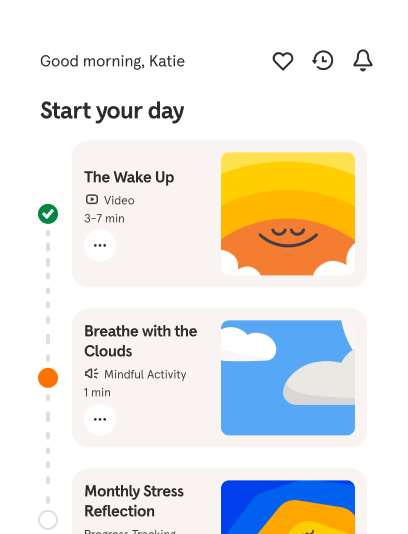
(air hissing) (computer mouse clicking) (shimmery music) Headspace Studios. (gentle music) Hey, friends, it's Rosie. Welcome back to "Radio Headspace." The other day, I was flying through my inbox. You know that feeling when you're on a roll, knocking things out, feeling very efficient, borderline unstoppable? And then, boom, it happened. I sent the wrong email to the wrong person. Nothing catastrophic, not career-ending, just one of those mix-up where the minute you hit Send, you realize, "Oh no, that wasn't meant for them." And before I even had the time to breathe, I heard myself say out loud, "Idiot," in my best Napoleon Dynamite voice. It stopped me in my tracks, not the mistake, the words, the way they rolled out of my mouth so naturally, like it was the most obvious truth in the world. And I thought, "Wait, did I just call myself an idiot out loud?" (gentle music continues) Look, we all have those moments: a slip-up, a stumble, a minor fail, and suddenly, the harshest voice in the room is our own. The technical term for this is negative self-talk, and it's more common than we realize. In fact, research shows that most people talk to themselves more harshly than they would ever dream of talking to a friend. And that, dear friend, is a trap. When our inner dialogue becomes a constant stream of criticism, it quietly erodes our confidence and our joy. The voice that's meant to guide us starts policing us instead. But here's the hopeful part: Because that voice was learned, it can also be retrained. With awareness and compassion, we teach our inner dialogue to sound more like a friend and less like a judge. Think about it. If your best friend sent the wrong email, would you look them in the eye and say, "Wow, you're such an idiot?" Probably not. You'd say, "Hey, it happens, no big deal." But when it's us, that inner critic does not hold back. (gentle music continues) Buddhist philosophy describes this as one of the super secret enemies: that deep hidden self-loathing that sneaks in under the radar. It's not always obvious. It doesn't announce itself. It whispers in those moments, "You're not good enough. You always mess up. You'll never get it right." And if we don't catch it, we start believing it. But the good news is, there is another way. Psychologist Kristin Neff has spent decades researching self-compassion: treating ourselves with the same kindness and understanding we'd offer a friend. And the studies are clear. People who practice self-compassion aren't less accountable for mistakes, they're actually more resilient, more motivated, and more likely to try again. Because when we stop making every misstep proof of our unworthiness, we free up energy to actually learn and grow. (gentle music continues) After I caught myself calling myself an idiot, I paused, I took a deep breath, and I asked, "Would I ever say this to someone else?" Of course not. So I tried again....
Details
About your teachers
 Andy PuddicomeHeadspace Co-founderMore about Andy
A former Buddhist monk, Andy has guided people in meditation and mindfulness for 20 years. In his mission to make these practices accessible to all, he co-created the Headspace app in 2010.
 Eve Lewis PrietoHeadspace Director of MeditationMore about Eve
Eve is a mindfulness teacher, overseeing Headspace’s meditation curriculum. She is passionate about sharing meditation to help others feel less stressed and experience more compassion in their lives.
 Dora KamauMeditation TeacherMore about Dora
As a meditation teacher, Dora encourages others to live, breathe, and be with the fullness of their experiences. She loves meditation’s power to create community and bring clarity to people’s minds.
 Kessonga GiscombeMeditation TeacherMore about Kessonga
Kessonga has been an acupuncturists, therapist, and meditation teacher, working to bring mindfulness to the diverse populations of the world.
 Rosie AcostaMeditation TeacherMore about Rosie
Rosie Acosta has studied yoga and mindfulness for more than 20 years and taught for over a decade. Rosie’s mission is to help others overcome adversity and experience radical love.

Your lifelong guide to better mental health
Stress, sleep, and all the challenging emotions — care for your mind with the everyday mental health app that's shown to make a difference.
Try 14 days free
Look after your mind
Proven guided meditations and programs to help you stress less, sleep more soundly, and better navigate life’s challenges

Science-backed
Studies show that using Headspace for 30 days can reduce stress, increase resilience, and improve overall well-being
Explore 1000+ expert-led exercises
Access our library of meditations, breathing exercises, and guidance videos for stress, sleep, focus, everyday anxiety , parenting, and more.






Members are enjoying happier and healthier lives
Related to 'The Words We Say To'




- © 2026 Headspace Inc.
- Terms & conditions
- Privacy policy
- Consumer Health Data
- Your privacy choices

- CA Privacy Notice