



Better mental health starts with Headspace. Unrivaled expertise to make life feel a little easier, using guided meditations, mindfulness tips, focus tools, sleep support, and dedicated programs.
Try 14 days free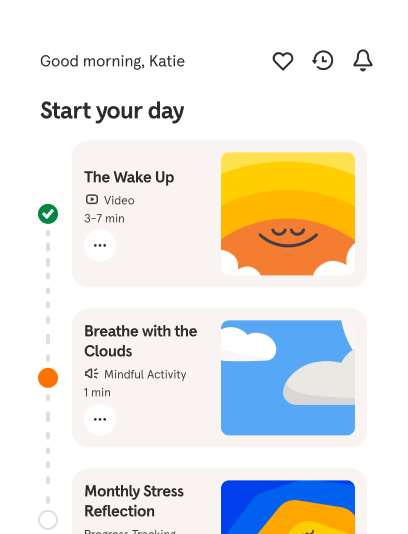
Get ready to lie down on your back if you can. And as you come to lie down, you can either leave your legs straight, or if it's more comfortable, bend your knees, and put your feet flat on the floor, whatever you prefer. We're going to start to pay attention to all the different parts of your body, and see how they're feeling now. So we can compare that to after we do our exercises. When you do this scan, don't label anything as good or bad, just notice how they feel. Starting from your feet, your legs, pelvis, low back, arms, neck, and head. There's no right or wrong sensation, we're just taking note, so that we can compare how you feel now to how you feel after you go through the exercise routine. Supine deep breathing. As you're lying on your back, you'll bring your hands onto the bottom part of your ribs, where your diaphragm is, and you want to make sure that as you bring your arms into this position, your neck, and shoulders, and head still remain just relaxed, and feel easy and soft. We're starting to breathe more deeply into the body here. And so, as you inhale, you should feel the ribs expand out into your hands. And as you exhale, they just return to their natural resting position. And as you breathe in, you should feel also there's that expansion into your belly. Not because you're trying to push your belly muscles out, but just that it occurs naturally as your diaphragm moves, and as the ribs expand. Deep breathing is a really nice way to connect into the relaxing part of your nervous system, so that you can feel both calm, but also focused and alert. If you're having a hard time feeling the ribs move, try placing your hands in a slightly different location, and see if that helps. And as you continue to breathe deeply, notice the effect of your breath on the whole of your body. If you start to feel your arms and legs a little more relaxed, or perhaps even a little more awake and energized. Take a moment now to just do a few breaths on your own. (soft music) Supine flow. As you're lying on your back, you'll bend your knees with your feet on the floor, and then start to bring your arms out to the side, and up overhead. Like you're doing a snow angel in the snow. You'll keep your palms facing up, and we're just using this to start a warm up, and bring more blood flow into the arms and the shoulders. As your arms come overhead, they may not reach the floor anymore, and that's totally okay. You just want to move your arms through whatever range feels comfortable, and like you're starting to gently warm up and energize your shoulders. Next, we'll move to your spine. And you're gonna start to take your knees over to...
Details
About your teachers
 Andy PuddicomeHeadspace Co-founderMore about Andy
A former Buddhist monk, Andy has guided people in meditation and mindfulness for 20 years. In his mission to make these practices accessible to all, he co-created the Headspace app in 2010.
 Eve Lewis PrietoHeadspace Director of MeditationMore about Eve
Eve is a mindfulness teacher, overseeing Headspace’s meditation curriculum. She is passionate about sharing meditation to help others feel less stressed and experience more compassion in their lives.
 Dora KamauMeditation TeacherMore about Dora
As a meditation teacher, Dora encourages others to live, breathe, and be with the fullness of their experiences. She loves meditation’s power to create community and bring clarity to people’s minds.
 Kessonga GiscombeMeditation TeacherMore about Kessonga
Kessonga has been an acupuncturists, therapist, and meditation teacher, working to bring mindfulness to the diverse populations of the world.
 Rosie AcostaMeditation TeacherMore about Rosie
Rosie Acosta has studied yoga and mindfulness for more than 20 years and taught for over a decade. Rosie’s mission is to help others overcome adversity and experience radical love.

Your lifelong guide to better mental health
Stress, sleep, and all the challenging emotions — care for your mind with the everyday mental health app that's shown to make a difference.
Try 14 days free
Look after your mind
Proven guided meditations and programs to help you stress less, sleep more soundly, and better navigate life’s challenges

Science-backed
Studies show that using Headspace for 30 days can reduce stress, increase resilience, and improve overall well-being

Explore 1000+ expert-led exercises
Access our library of meditations, breathing exercises, and guidance videos for stress, sleep, focus, everyday anxiety , parenting, and more.






Members are enjoying happier and healthier lives




- © 2026 Headspace Inc.
- Terms & conditions
- Privacy policy
- Consumer Health Data
- Your privacy choices

- CA Privacy Notice