

Ask What You Need, Not What's Wrong
The next time anxiety, insecurity, or discomfort shows up, skip the diagnosis for a moment. Notice what’s happening in your body and ask, “What do I need right now?” Maybe it’s reassurance. Maybe it’s space. Maybe it’s one deep breath. You can respond to the experience without turning it into a verdict about yourself.
Try 14 days free

Better mental health starts with Headspace. Unrivaled expertise to make life feel a little easier, using guided meditations, mindfulness tips, focus tools, sleep support, and dedicated programs.
Try 14 days free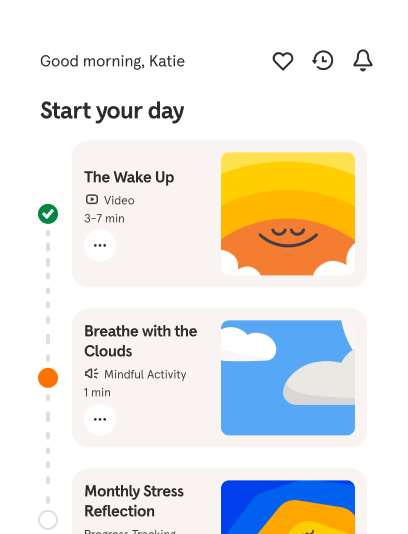
(click resounds) (warm upbeat music) Headspace Studios. (gentle upbeat music) Hey, friends. It's Rosie here. Welcome back to "Radio Headspace." Recently, I was sitting with my niece. She's 19, bright, thoughtful, and right in that stage of life where everything feels like it's being discovered for the first time, including yourself. We were talking about school, about what she might want to do next, and then the conversation shifted. She started listing things about herself quickly, almost like she'd been waiting to say it out loud. "I have anxious attachment," she said. "And I think I have this other thing too, and probably this." She paused for a second and added, almost casually, "I mean, I saw it on TikTok." She wasn't joking. She was trying to understand herself, and I sat there and I listened. Every once in a while I would ask, "What does that mean to you?" Or, "How does that show up for you?" I wasn't correcting her, though I wanted to. I wasn't confirming it either. I was just trying to slow the moment down because I could hear something underneath the labels. I could hear the effort to make sense of her experience. And honestly, I get it. (gentle upbeat music) I've shared here before that I'm no stranger to diagnosing myself via the internet. I've gone down many late night rabbit holes trying to figure out what's wrong with me. A headache becomes something serious. A feeling becomes a condition. As a self-proclaimed hypochondriac, I know that pattern well. So in that moment, I had to ask myself, "What's the difference?" The difference isn't that one is right and the other is wrong. The difference is, what do we do with the information? There's something comforting about having a name for what we feel, right? It organizes the chaos. It gives us language. It tells us we're not alone, and especially for younger generations, that language is more available than it's ever been, but there's also a risk. When we move too quickly from, "This is something I feel," to, "This is who I am," we start to close the door before we've really looked around the room. We turn a moment into a definition, and that definition can feel solid, fixed, maybe even permanent. (soft instrumental music) Anxious attachment is a real thing. So is insecurity. So is the feeling of waiting for a text that doesn't come and suddenly imagining every possible explanation for why. That tightness in the chest, that quickening in the mind, that urge to check, to reach, to fix the discomfort, that's human. But when we say, "This is who I am," instead of, "This is what I'm experiencing," something subtle happens. We stop relating to the feeling and we start identifying with it. We become it, and the moment we become it, it becomes harder to imagine moving through it. So as my niece was talking, I wasn't trying to take anything away from her. I wasn't...
Details
About your teachers
 Andy PuddicomeHeadspace Co-founderMore about Andy
A former Buddhist monk, Andy has guided people in meditation and mindfulness for 20 years. In his mission to make these practices accessible to all, he co-created the Headspace app in 2010.
 Eve Lewis PrietoHeadspace Director of MeditationMore about Eve
Eve is a mindfulness teacher, overseeing Headspace’s meditation curriculum. She is passionate about sharing meditation to help others feel less stressed and experience more compassion in their lives.
 Dora KamauMeditation TeacherMore about Dora
As a meditation teacher, Dora encourages others to live, breathe, and be with the fullness of their experiences. She loves meditation’s power to create community and bring clarity to people’s minds.
 Kessonga GiscombeMeditation TeacherMore about Kessonga
Kessonga has been an acupuncturists, therapist, and meditation teacher, working to bring mindfulness to the diverse populations of the world.
 Rosie AcostaMeditation TeacherMore about Rosie
Rosie Acosta has studied yoga and mindfulness for more than 20 years and taught for over a decade. Rosie’s mission is to help others overcome adversity and experience radical love.

Your lifelong guide to better mental health
Stress, sleep, and all the challenging emotions — care for your mind with the everyday mental health app that's shown to make a difference.
Try 14 days free
Look after your mind
Proven guided meditations and programs to help you stress less, sleep more soundly, and better navigate life’s challenges

Science-backed
Studies show that using Headspace for 30 days can reduce stress, increase resilience, and improve overall well-being

Explore 1000+ expert-led exercises
Access our library of meditations, breathing exercises, and guidance videos for stress, sleep, focus, everyday anxiety , parenting, and more.






Members are enjoying happier and healthier lives
Related to 'Ask What You Need Not Whats'




- © 2026 Headspace Inc.
- Terms & conditions
- Privacy policy
- Consumer Health Data
- Your privacy choices

- CA Privacy Notice